
From Good Practice to Daily Practice in Baltic Ports
What if simple changes in how ports handle cargo could help reduce pollution in the Baltic Sea while also saving valuable resources? This is exactly what PortSHAZ, an EU Interreg South Baltic project, aims to achieve by exploring practical ways to prevent nutrient- rich cargo from entering the sea.
Every time dry bulk cargo is transferred between a ship and the quay, some of it risks being lost. For ports, this means lost products and economic value. For the Baltic Sea, it can mean additional nutrients contributing to eutrophication.
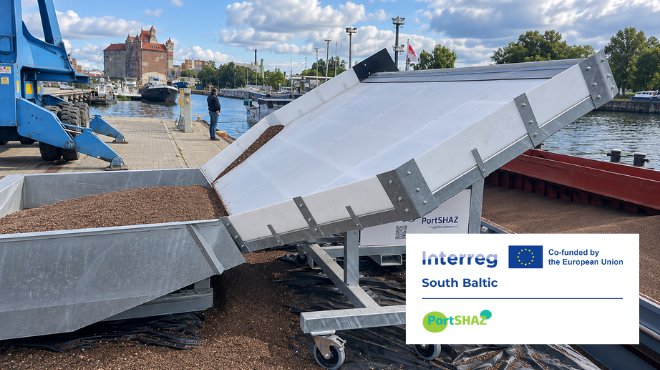
In early September, Race For The Baltic and project partners tested a prevention cover at the Port of Elbląg in Poland. The cover creates a barrier between the ship and the quay, collecting cargo that might otherwise fall into the water. During the handling of buckwheat, the amount collected corresponded to 1.2% of the handled cargo, equivalent to approximately 7 tonnes. This demonstrates how a relatively simple solution can help protect both valuable resources and the marine environment.
Beyond this pilot, PortSHAZ has developed a toolbox of 84 good practices (Dry Bulk Cargo Handling and Baltic Sea Eutrophication report) to help ports reduce pollution from dry bulk cargo handling. These include improved cargo-handling infrastructure, quay cleaning, stormwater management, dust prevention and personnel training.
Race For The Baltic recently shared experiences from this work at the HELCOM Maritime Working Group, highlighting how practical solutions can support the implementation of Best Available Techniques and Best Environmental Practices (BAT/BEP).
An important part of the project is also looking beyond fertilisers. Ports handle many other nutrient-containing materials, including grains, feed, pellets and biomass, which may also contribute to nutrient pollution when lost during handling.
The PortSHAZ experience highlights an important opportunity: turning good practices into everyday port operations, where preventing cargo losses can create benefits for both businesses and the Baltic Sea.
The project is co-funded by the European Union through the Interreg South Baltic Programme.