
Dry Bulk: Bringing port sustainability into action
The first quarter of 2026 has been a busy one for us on the port sustainability front. Much of our energy has gone into the PortSHAZ project, and in late March, we saw that work come together in a very concrete way.
From Development to Deployment: Prevention Cover Moves Toward Pilot Phase
Over the past few months, RFTB has been developing a practical solution to one of the most persistent challenges in dry bulk operations: preventing cargo from entering the marine environment during loading and unloading. The result is a prevention cover—a tool we have designed and are now preparing to build. While our focus within PortSHAZ is on small and medium-sized ports, where the need is real and dedicated resources are often limited, we see this as a solution with broad relevance: any port or terminal handling dry bulk cargo stands to benefit.
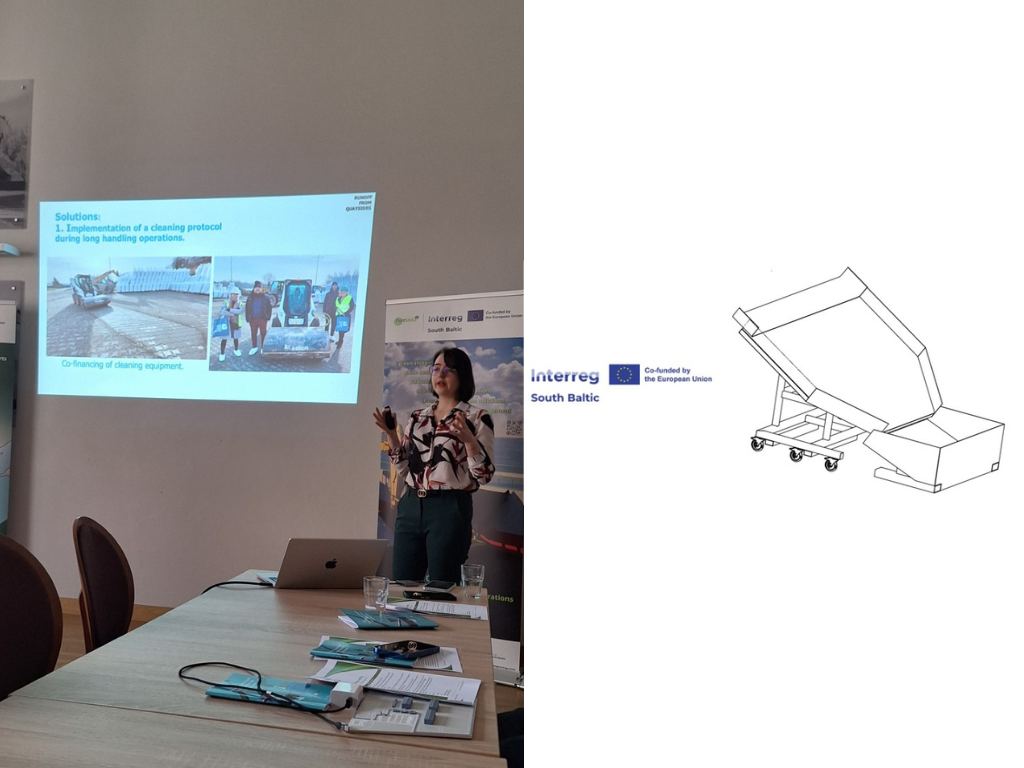
Showcasing the prevention cover and pathways to more sustainable ports at the PortSHAZ Synergy Meeting in Elbląg. © Race For The Baltic
Collaboration and Knowledge Sharing
Alongside the technical development, we have continued our long-standing cooperation with ports and terminals to reduce eutrophication, including our presence at the Transport Week conference.
In late March, Race For The Baltic co-organised the Synergy Meeting in Elbląg, hosted together with the Port of Elbląg and bringing together three EU-funded initiatives: PortSHAZ, DigiTechPort2030, and INCONE60Green. It was an opportunity to share results and practical approaches across projects—and, for us, a chance to present what we have been working on.
Our Business Manager, Małgorzata Żochowska, introduced the prevention cover to the broader partnership and announced that the Port of Elbląg will pilot it starting in mid-May—a milestone we have been building towards all quarter.
The timing is particularly apt: the Port of Elbląg is planning significant expansion, including a new terminal and major dredging works. This means cargo volumes—and the importance of prevention—are only set to grow.
The presentation also went beyond the cover itself. Małgorzata highlighted the broader issue at stake: how ports contribute to eutrophication, why it remains one of the most pressing environmental challenges in the Baltic Sea region, and the multiple pathways through which cargo can enter the marine environment. While the prevention cover addresses one critical route, it is far from the only one—and RFTB is already considering what comes next.
Day two of the meeting brought another highlight: the official signing of a partnership agreement with the Port of Vordingborg, whose ambitious team is now joining the PortSHAZ project—a strong way to close out the quarter.