
GYPREG Poland: Royal visit to Gypsum demonstration
Advancing Gypsum Solutions for a Healthier Baltic Sea
On February 27th, together with the Instytut Technologiczno-Przyrodniczy in Kraków, we hosted an online webinar bringing together researchers, farmers, advisors and public institutions for a discussion on the potential of gypsum application in Polish agriculture. The event was organised within the GYPREG project and explored how gypsum can help reduce phosphorus runoff from agricultural soils—an important step in tackling eutrophication in the Baltic Sea.
Participants heard about experiences with gypsum use in other Baltic Sea countries, early results from GYPREG field and laboratory experiments, and findings from a nationwide survey on awareness of the method among Polish farmers and advisors. The discussions also covered practical benefits for soils, water quality and local communities.
We were very pleased to see such a strong turnout, with representatives from universities, research institutes, advisory services, public administration and the farming community. The conversation highlighted both the opportunities and the remaining questions around implementing gypsum application in Poland—and, most importantly, showed a shared willingness to work together towards healthier soils and a healthier Baltic Sea. The insights gathered will help shape the next steps of the GYPREG project and future cooperation.
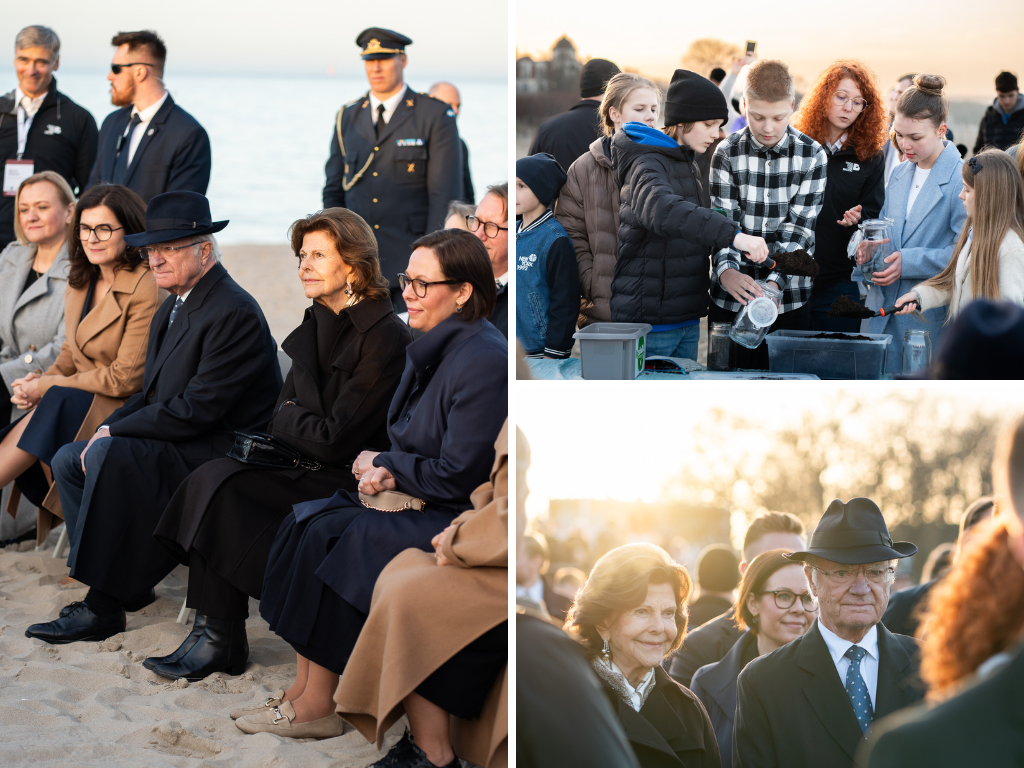
Their Majesties King Carl XVI Gustaf and Queen Silvia during a hands-on demonstration at the Gdańsk beach, highlighting gypsum’s role in reducing phosphorus runoff from agriculture. Photos: Sara Friberg, Copyright Kungl. Hovstaterna/The Royal Court of Sweden.
Gypsum on the Baltic Shore: A Royal Demonstration
On 12th March, we had a memorable opportunity to present the potential of gypsum in agriculture to Their Majesties King Carl XVI Gustaf and Queen Silvia during their visit to Gdańsk. Right by the Baltic Sea, we conducted a short hands-on demonstration experiment illustrating how gypsum application can help reduce phosphorus runoff from agricultural soils. It was a powerful setting to convey the direct link between farming practices on land and the health of the sea—and a valuable opportunity to bring the GYPREG project to a wider, high-profile audience.
Connecting at the European Agricultural Forum
On 1–2 April, we attended the European Agricultural Forum (Forum Jasionka)—one of Poland's key gatherings on the future of agriculture. The two-day programme covered a broad range of topics highly relevant to our work, from soil health and regenerative practices to water management and climate adaptation.
Attending provided valuable insight into the priorities and pressures shaping the agricultural sector, and helped us better understand the broader context in which gypsum application and Baltic Sea water quality efforts must be positioned. It was also an excellent opportunity to connect with researchers, advisors and policymakers working at the intersection of agriculture and sustainability.
With growing interest, new partnerships, and scaling opportunities on the horizon, the coming months promise important developments for gypsum application in Poland—more to follow soon.