
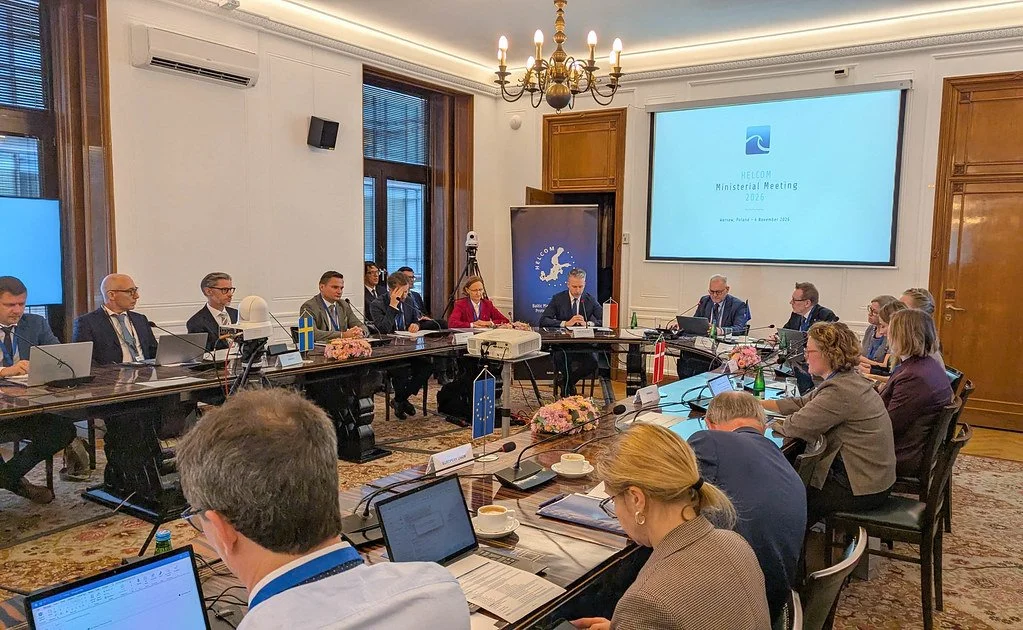
The HELCOM Ministerial Meeting in Warsaw. Photo: HELCOM
On 4 November, ministers from around the Baltic Sea met in Warsaw for the 2026 HELCOM Ministerial Meeting. The meeting concluded without the adoption of a Ministerial Declaration. In our written statement, Race For The Baltic urged HELCOM Contracting Parties to move from plans to delivery, and to measure progress in tonnes of nutrients reduced, not only in policies announced.
The Baltic Sea is proof that regional cooperation works. Since the early 2000s, nitrogen inputs to the sea have fallen by 11% and phosphorus inputs by 30%. Yet the sea is far from healthy. 94% of its area is still below good status for eutrophication, and the reductions still needed will have to come from land.
HELCOM’s 2025 assessment shows that even if every planned measure is carried out, around 3,600 tonnes of phosphorus a year still have no measures behind them.
About a quarter of the remaining phosphorus reduction lies with Russia and Belarus. HELCOM cooperation with Russia has been on hold since 2022, and Belarus is outside the Convention, so neither can currently be held to account. Until that changes, the rest of the region must do more, and faster, on its own side. A warming climate makes this more urgent, as it partly counteracts the reductions already achieved.
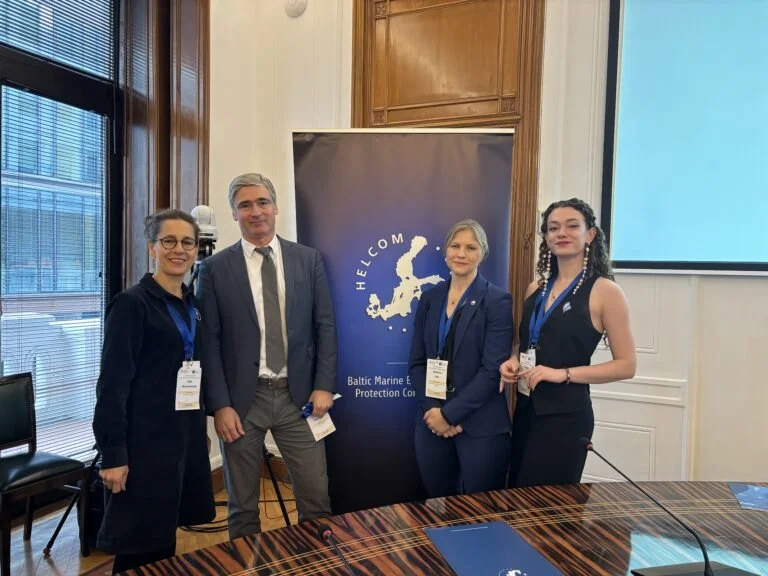
At the Ministerial Meeting we joined WWF Baltic Sea Programme, Coalition Clean Baltic and the John Nurminen Foundation in a joint oral statement. Together, we stressed the value of regional cooperation and called on governments to turn long-standing commitments into concrete action. Representatives from John Nurminen Foundation, Race For The Baltic, WWF and Coalition Clean Baltic. Photo: Emma Gemal
Solutions exist, implementation is lacking
“The Baltic Sea does not lack solutions. It lacks implementation at the scale needed,” says Marcin Kotlarek, CEO of Race For The Baltic.
Race For The Baltic has committed to helping cut annual phosphorus inputs to the Baltic Sea by 500 tonnes by 2030. We stand ready to work with the Polish Chairship, all Contracting Parties and partners across the region to scale what works.
Six steps to close the gap
In our written statement, which can be found here, we urged the HELCOM Contracting Parties to:
Turn national ceilings into catchment plans. Each country should publish a costed plan to close its remaining nitrogen and phosphorus gap, with milestones through 2030 and targets for priority river catchments. For EU Member States, the river basin management plans due by the end of 2027 are the natural vehicle. Denmark, which sets reduction needs for each coastal catchment, is the only country on track to meet both its nitrogen and phosphorus ceilings by 2030.
Scale proven solutions. Gypsum treatment of clay soils, wetlands, better manure management and nutrient recovery through biogas all work. Without simpler approvals, aligned rules for by-products and dedicated funding, they will stay pilots.
Bring dispersed wastewater into the light. In Poland alone, about 10 million people live outside the sewer network. We estimate that poorly managed septic systems there could release more than 1,000 tonnes of phosphorus a year, largely unnoticed. Reliable registers, regular inspections and accessible funding for repairs are needed, and the revised Urban Wastewater Treatment Directive will not solve this for dispersed households.
Strengthen enforcement. Rules only work if they are enforced. Environmental inspectorates need staff, powers and digital tools, from shared datasets to satellite imagery and AI-assisted risk analysis, to focus scarce capacity where breaches are most likely.
Hold large point sources accountable. Fertiliser plants, large animal farms, ports and dry-bulk terminals can cause concentrated nutrient losses. Permits, monitoring and safe handling of manure, stormwater and bulk materials must be tightened.
Invest in public understanding. Many farmers, households and businesses do not connect everyday wastewater and fertiliser practices with the health of their local waters. Sustained, practical campaigns can make that link visible and help people change.
From pilots to scale: our side event in Warsaw
Alongside the ministerial meeting, Race For The Baltic hosted the side event The Baltic Sea starts on land: solutions for faster nutrient reductions, a recording of the side event can be found here.
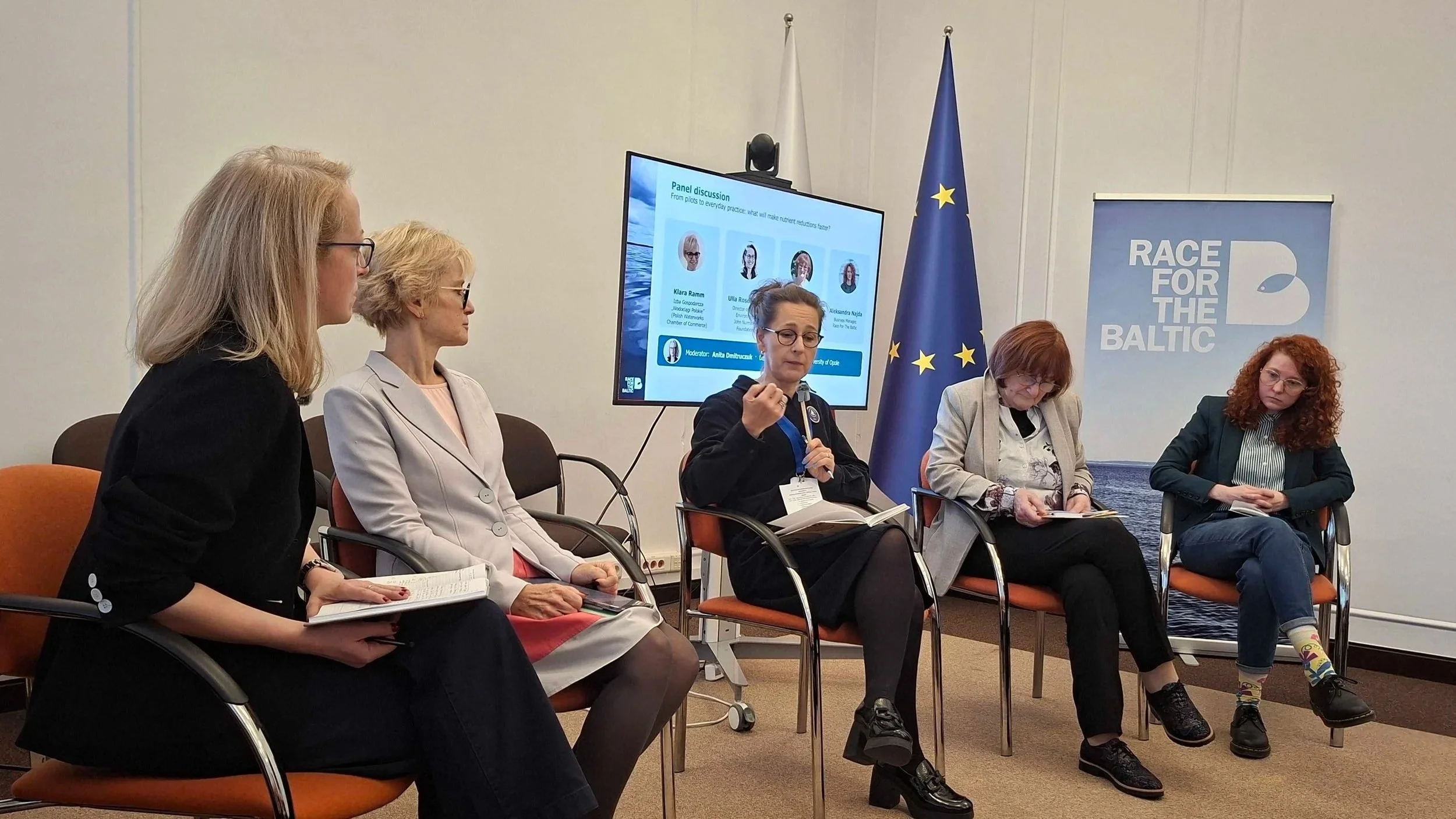
A panel discussed what it will take to turn pilots into everyday practice. The panellists were Klara Ramm (Polish Waterworks Chamber of Commerce), Ulla Rosenström (John Nurminen Foundation), Maria Staniszewska (Polish Ecological Club) and Aleksandra Najda (Race For The Baltic), with Anita Dmitruczuk (Dziennik Gazeta Prawna / University of Opole) as moderator. Photo: RFTB
In his keynote, Marcin Kotlarek showed how the challenge has changed. The “big pipes” are largely fixed: Tallinn, for example, has cut its phosphorus discharge from 137 to 17 tonnes a year. What remains comes from millions of diffuse sources: fields and manure, septic tanks, stormwater and ports. Poland alone holds more than half of the region’s remaining phosphorus reduction requirement.
The tools to tackle this already exist. Gypsum on clay fields halves phosphorus losses at half the cost per kilo of buffer zones. Replacing a leaking septic tank pays for itself in about a year. On a fertiliser quay on the Odra, a sediment trap and new cleaning routines cut phosphorus losses by 80%, avoiding 9 tonnes in 2025. In a Polish city of more than 500,000 people, a digital septic-tank register increased the amount of wastewater reaching treatment 16-fold.
So why do good pilots so rarely become standard practice? Ownership of the problem is fragmented, rules are unclear, funding ends with the project, and data and enforcement are weak. To move from pilot to national standard, five accelerators were outlined: turn pilots into playbooks anyone can copy, finance solutions at scale, set clear and enforced rules, use digital tools to find leaks and verify results, and build coalitions one catchment at a time.
The presentation from the side event can be found here.