
GYPREG: field trials clearly indicate a reduction of phosphorus leakage
First results from Swedish field trials
The Swedish field trials are one of the main activities in GYPREG Sweden. In the trials, we are testing how gypsum spreading on fields can give the soil better structure and reduced phosphorus leakage. Both gypsum and structural lime are included, to provide an understanding of the similarities and differences between the two soil amendments.
During summer season 2025, spring barley was growing in the trial fields. By the end of the season, the crop was harvested and sampled, together with a large number of soil samples. The long-awaited results have now started to come. The initial numbers show promising results, both regarding harvest and nutrient leakages. Harvest levels are the same as in the reference case, while the indications are that the phosphorus runoff clearly decreases. The last group of soil samples are still in the laboratory for rain simulation, giving us more answers on the nutrient leaching effect in a couple of months.
Gypsum treatment in new HELCOM report
Another key objective of the GYPREG project is to increase the awareness in the Baltic Sea Region regarding gypsum treatment as a method for reduced nutrient runoff from farmland. In the beginning of October, HELCOM released a new guideline on “Best practices to improve soil structure and aggregate stability on clay soils”. In the section of new methods, gypsum treatment was thoroughly described, covering both suitability, efficiency and examples from Finland. This publication is highly valuable in the continued dialogue with stakeholders in both Sweden and Poland, bringing important information and reliability.
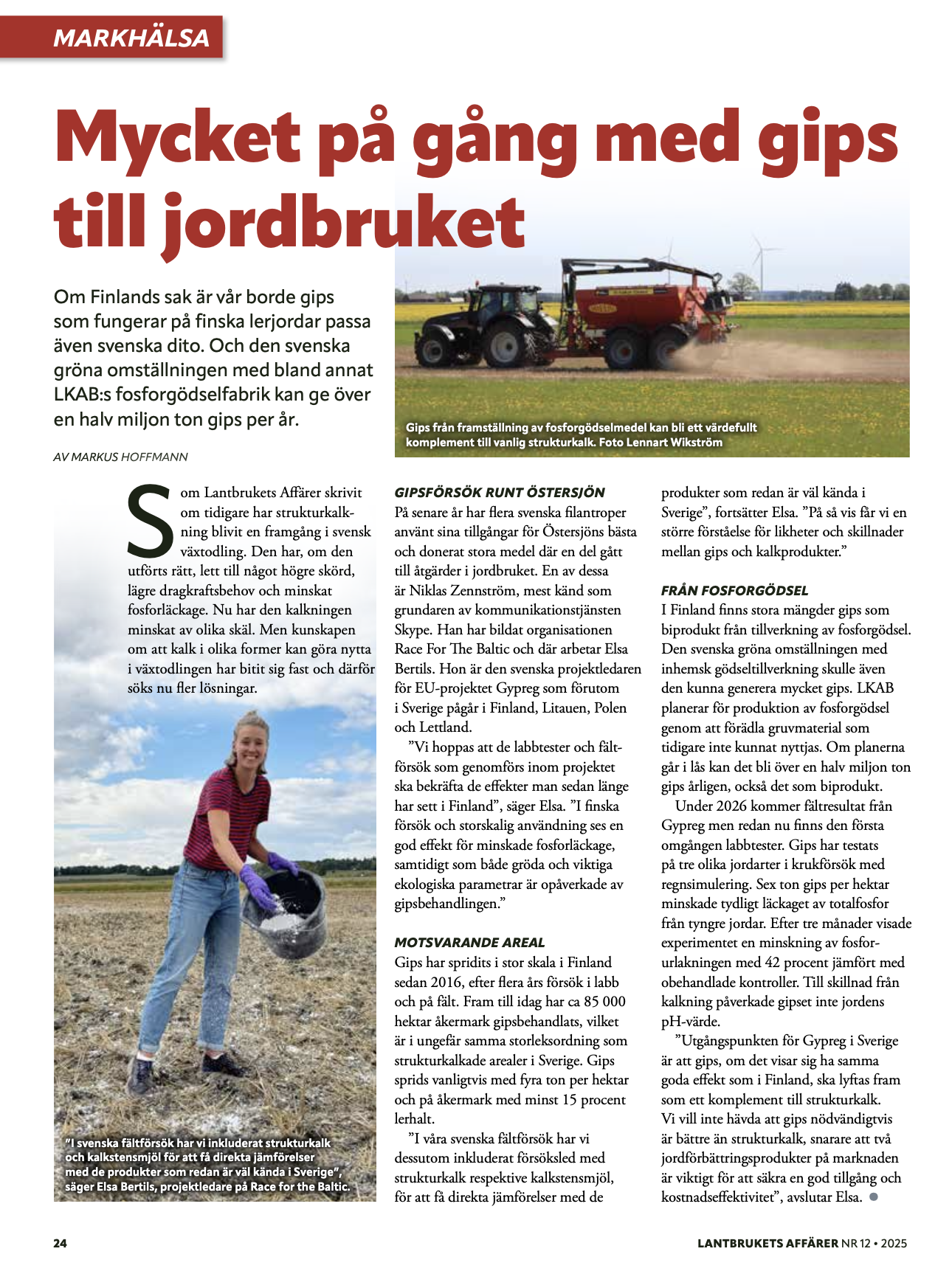
In the theme of awareness and communication, another important achievement was reached in Sweden. In the December edition of Lantbrukets Affärer, a large agricultural magasine in Sweden, gypsum treatment and the GYPREG project were described in a full-page article. As the field trial results are coming in, even more focus will be placed on reaching out to the agricultural sector in general and farmers and advisors in particular. Read the new guideline here.
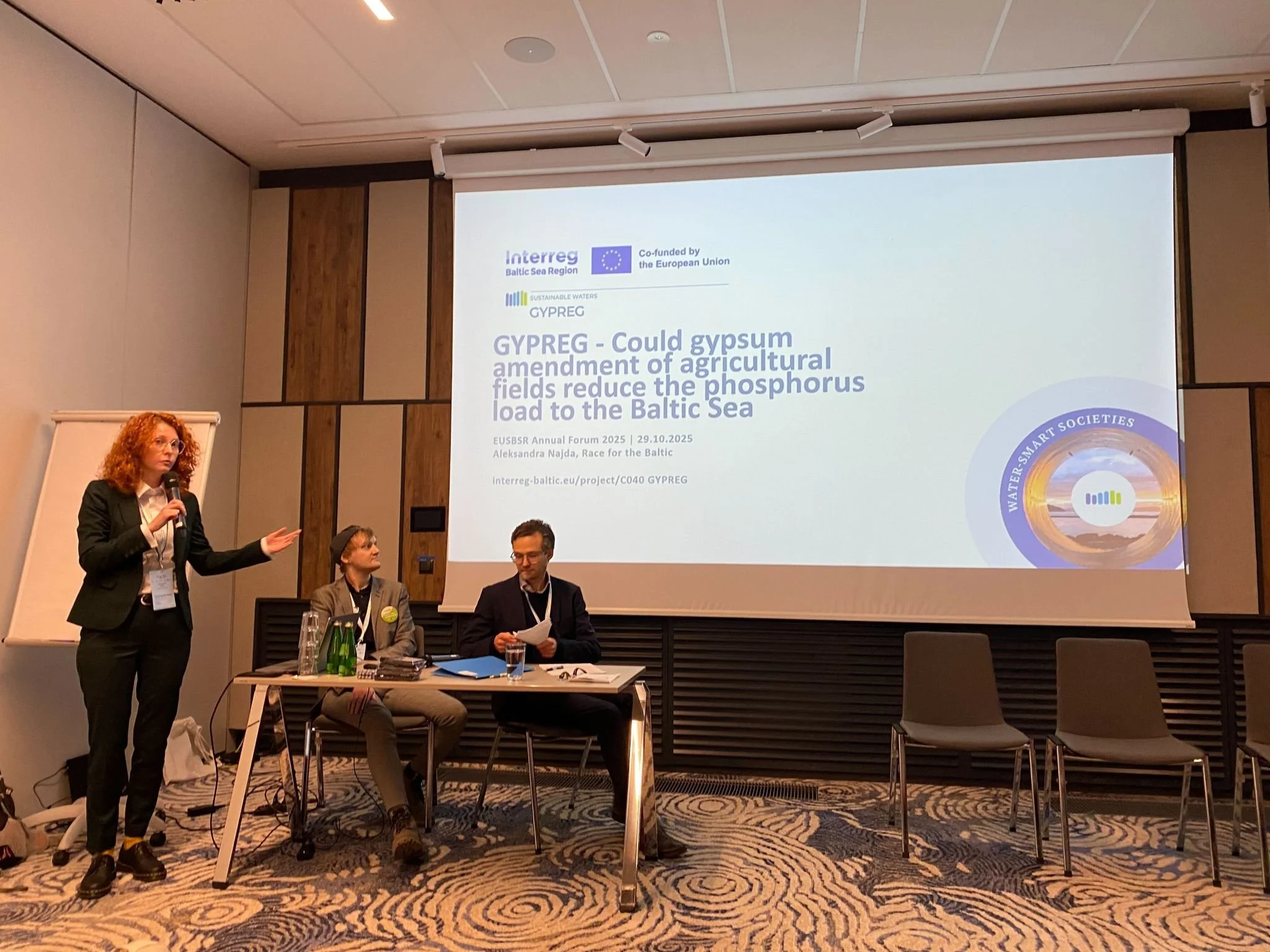
GYPREG at EUSBSR Annual Forum in Sopot
Race For The Baltic represented the GYPREG project at the EU Strategy for the Baltic Sea Region Forum in late October— a key gathering connecting policymakers, businesses, and civil society to accelerate a smarter, greener and more connected region. The event highlighted the power of regional cooperation in tackling shared environmental challenges.
During the New Circular Economy Solutions panel, our Business Manager Aleksandra Najda presented GYPREG — an innovative approach to nutrient recycling that transforms industrial by-products into value for both farmers and the environment. By linking agriculture, industry, and the Baltic Sea, GYPREG shows how circular solutions can reduce nutrient pollution while strengthening resilient production systems.
During the following panel discussion, the curiosity from the audience was high and Aleksandra got several interesting questions and comments. We are thankful for the opportunity to talk about the project and proud to contribute to the growing momentum behind circular transition in the Baltic Sea region. An excellent forum to showcase practical solutions that deliver environmental and economic benefits hand-in-hand.
Partner meeting in Åland
In the middle of October, all GYPREG project partners met in Åland for two productive days of collaboration, learning, and planning as the project enters its final year. Race For The Baltic led a workshop focused on how gypsum treatment could be organised and implemented in each participating country. The active engagement and exchange of perspectives among partners contributed to a clearer path forward for the project’s next steps. As GYPREG moves toward its conclusion, partners are aligning efforts to summarise results and plan final activities. Collaboration across countries and sectors remains essential to reducing nutrient runoff and improving water quality in the Baltic Sea.
Another key highlight of the meeting was a field demonstration organised by John Nurminen Foundation, where participants could see gypsum spreading in action and experiments showing its immediate effect on soil structure and nutrient leaching. The event gathered local farmers, advisors, and media, providing valuable insight and inspiration for future demonstrations across the Baltic Sea region.
For the Swedish speakers: tune in to Ålands Radio and listen to interviews with experts and farmers engaged in the project, listen here!